
Understanding the swing
The window of tolerance is a concept developed by psychiatrist Dr Dan Siegel. It describes the zone in which our nervous system is regulated enough for us to function well: to think clearly, take in information, feel our feelings without being flooded by them, and manage the ordinary stresses of a day. It isn’t a place of constant calm or happiness, but a place where we have enough capacity to stay present with whatever is happening, whether that’s a difficult conversation, a change of plan or a loud room.
Inside the window we tend to feel grounded and flexible. We can think, make choices, and respond rather than react. Life still goes up and down in here, but our system can hold it.
When something pushes us beyond the edges of the window, our nervous system shifts into a survival response. That is neither a decision nor a flaw, but our body doing what bodies are designed to do when they sense that what’s in front of them is too much.
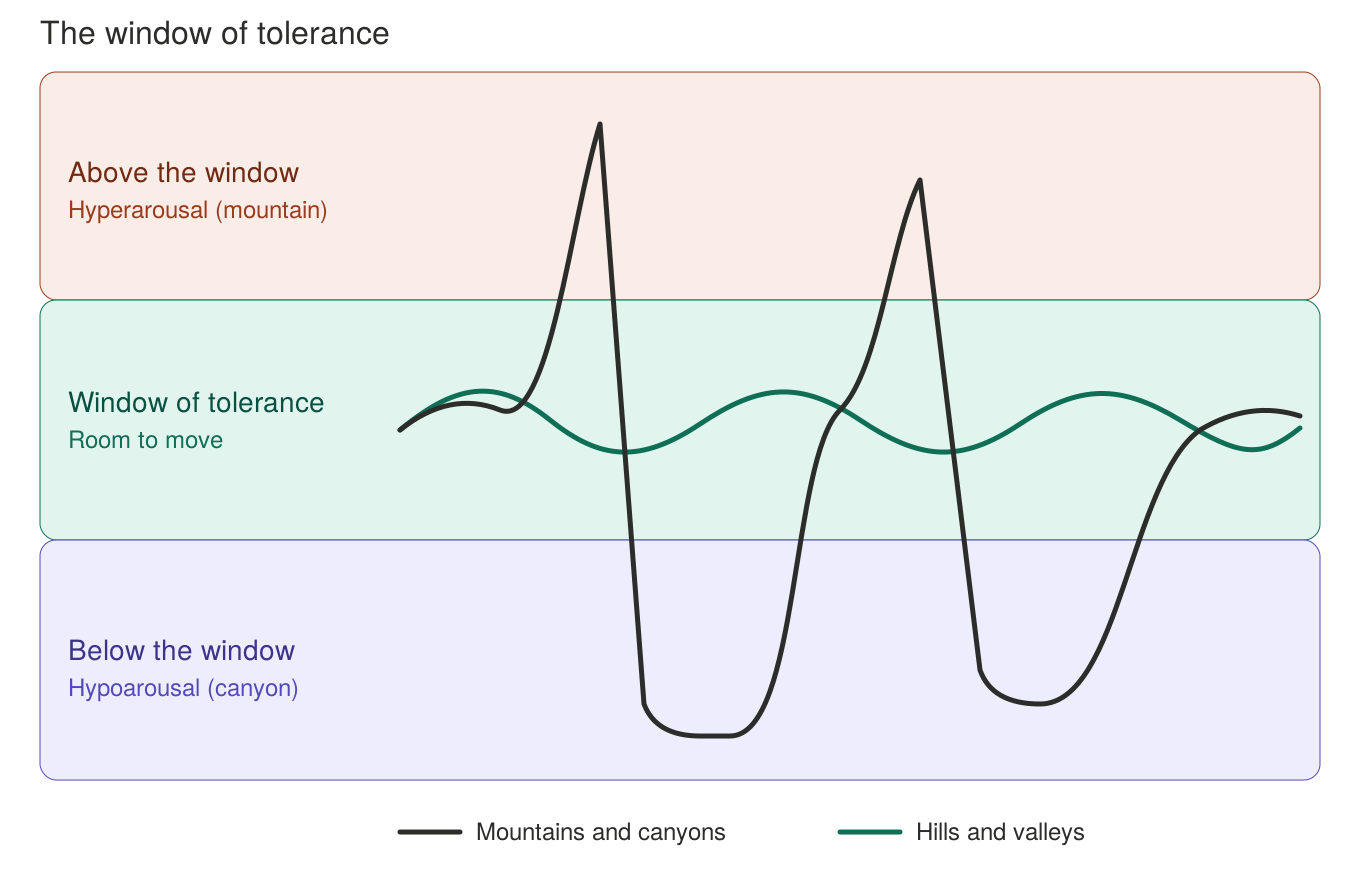
With clients, I often use the concept of smoothing mountains and canyons into hills and valleys as a way of helping us to understand the swings and to recognise and widen our window of tolerance.
Think of hills and valleys as the ups and downs of life that sit within our window of tolerance. Mountains and canyons are the peaks and drops out with it, which often swing from one to the other.
Above the window: the mountain
When we go beyond the upper edge of our window of tolerance, we enter hyperarousal and the fight-or-flight response. I think of this as the mountain.
On the mountain, everything speeds up. Our thoughts might move faster than we can follow them, and suddenly there are a hundred things that need doing, all of them urgent. We may say yes to more, take on more, or find we can’t seem to stop. We might become restless, or stopping and slowing down may feel unbearable.
Sometimes it can feel like we’re being super productive and capable, and people around us may praise us for it. That’s partly why it’s so easy to miss, or to change, because it can feel like simply what we need to do to get things done. It can be driven by a sense of demand, from the outside world or from the voice inside our own heads, telling us that we need to keep going and that stopping would feel worse.
I personally know this place well and for a long time, pushing through was only what I knew to do. When things felt like too much, my answer was always to do more, go faster and try harder, and I kept going long after my body and mind had been asking me to stop. I couldn’t have told you I was in hyperarousal or fight or flight. I would have told you I was being productive.
Below the window: the canyon
The canyon is below the window of tolerance. It’s also called hypo-arousal, shutdown and the freeze response. This is where our system powers down. We might feel foggy, numb, exhausted or disconnected, as though we’re watching life from behind glass. Words don’t come, tasks feel impossible, and even the things we care about feel far away. For many of us this is the state we can feel most ashamed of because from the inside it can feel like we’ve simply stopped being able to do anything useful or productive. Our brain might convince us that this experience says something about who we fundamentally are, and these are seldom positive things. But it’s not who we are - it’s the nervous system’s way of dealing with too much.
These two states outwith the window of tolerance are relative to each other. The higher we climb, the further there is to fall. And the deeper the canyon, the more tempting it is to grab the first burst of energy that comes along and race up the nearest peak to get out of it. They aren’t two separate states.
They’re two ends of one swing.
Why the window can be narrower for some of us
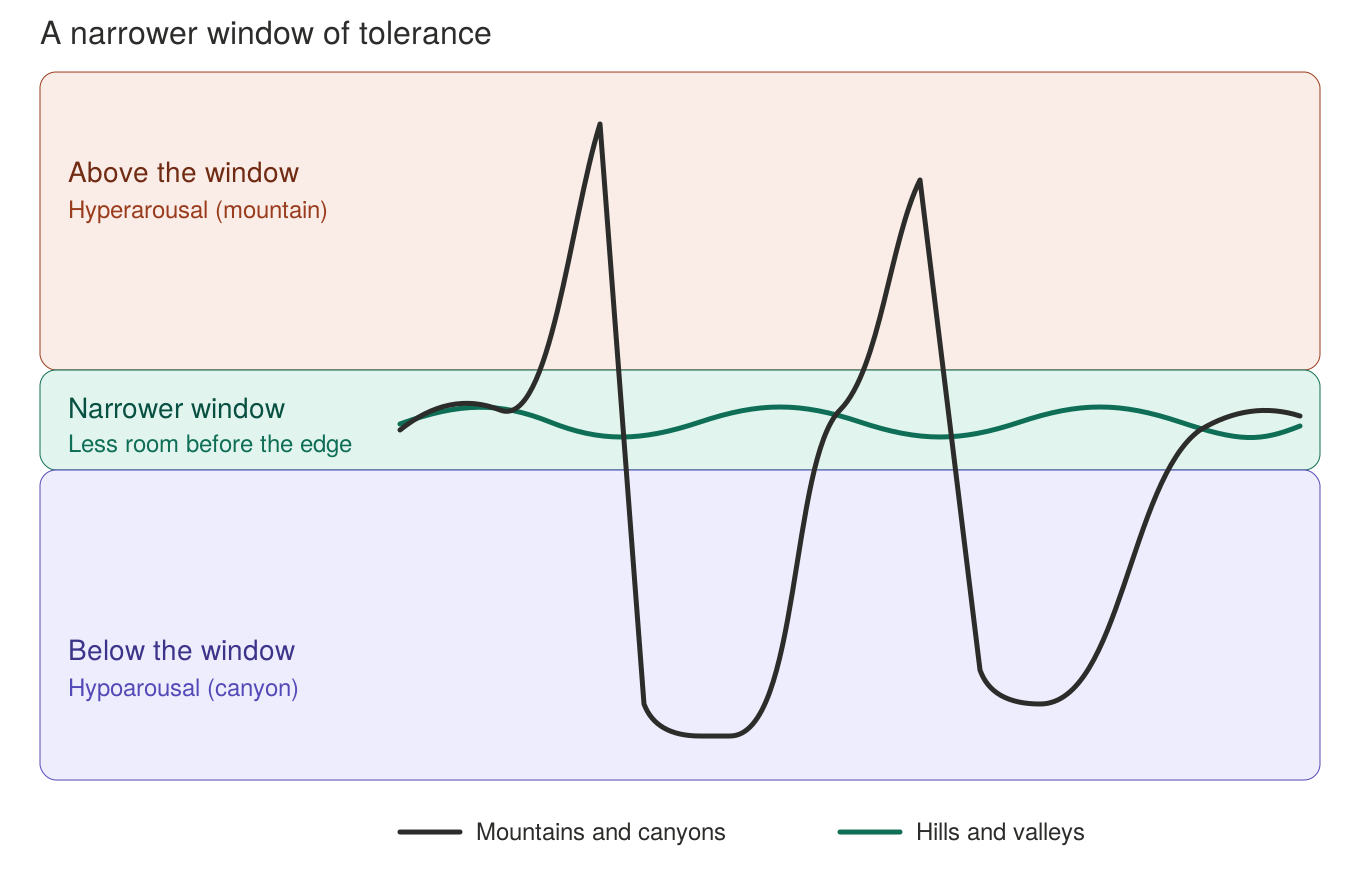
For many neurodivergent people, including those of us who are autistic, ADHD or both, the window can be narrower and can shift more from day to day. We often experience sensory, social and emotional information with greater intensity, and masking uses up an enormous amount of energy that we don’t always notice we’re spending. Add years of pushing through, environments not built for our brains, poor sleep, or going without what our bodies need, and our resources can be depleted before the day has even started.
If eating or our relationship with our body has been difficult too, that can add another layer. Hunger, fullness, thirst and tiredness are all messages from the body about where we are. If we’ve learned to override them, or they’ve never come through very clearly, we can find ourselves a long way outside the window before we’ve had any warning at all.
Widening the window
However, it IS possible to widen the window, and this is usually our aim. That doesn’t mean staying inside it all the time, but building a bit more room, so that the things that used to tip us into hyper or hypo arousal (i.e. up a mountain or down a canyon) tip us less often, and less far. It can mean that ultimately we have more capacity at less energy cost – or at least we have more choice over where we direct our energy and it’s more sustainable.
This is a skill that can be learned.
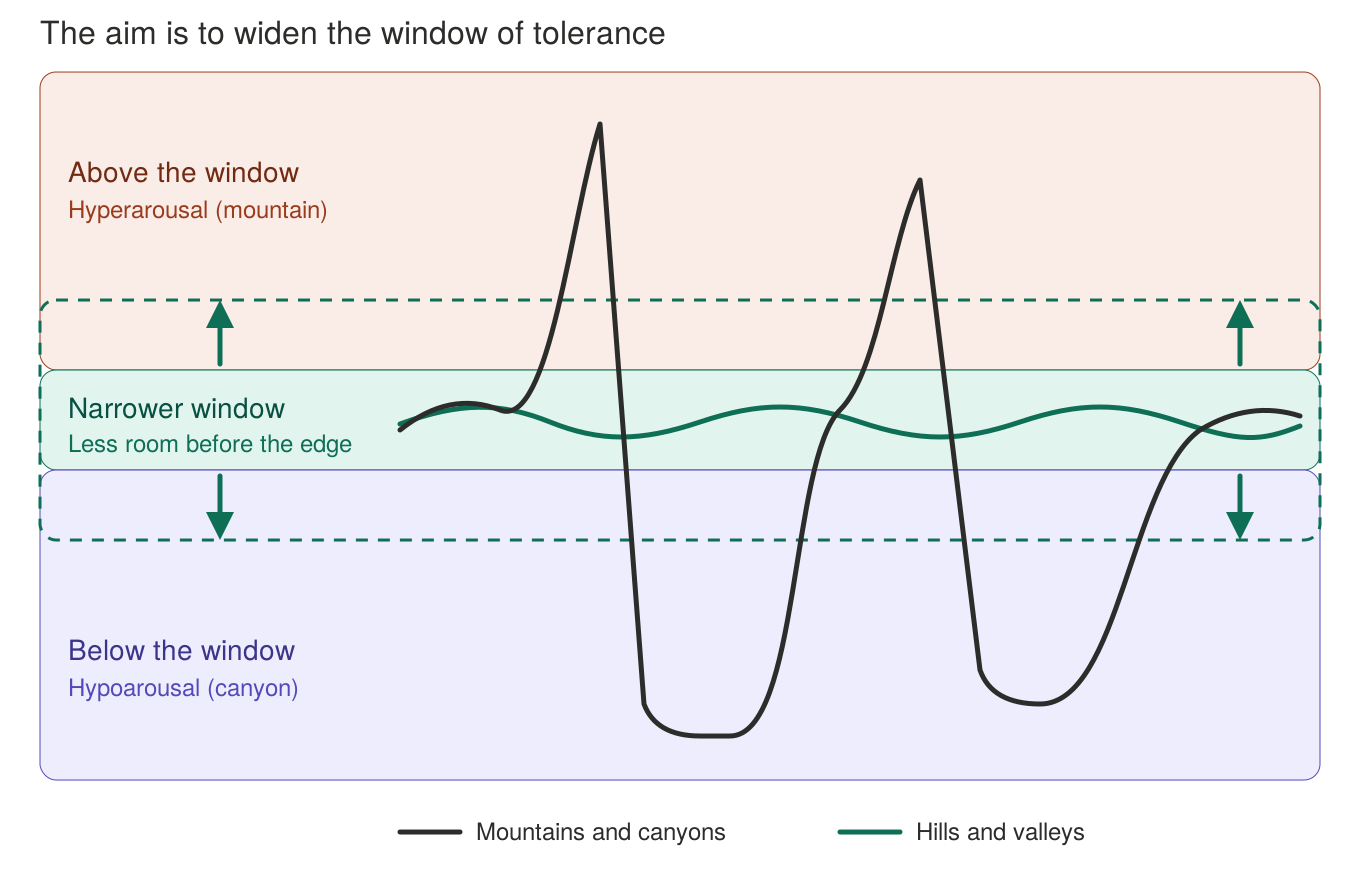
It happens gradually though. Forcing ourselves out of each state tends not to help and can keep the swinging between them going.
Often the starting point is with building awareness. Forming an ability to notice and be curious about where we are in the window, or whether we’re heading towards a mountain or a canyon, can be really helpful.
To begin with, this can be really difficult and it’s often only in hindsight that we can reflect back and notice when the shift out of the window of tolerance started. We can learn over time what it feels like in the body, in our energy, or in the pattern of our thoughts or behaviours just before tipping into overwhelm. And we can learn to recognise what the first signs of a shutdown are.
Noticing afterwards is how we gradually start to notice sooner, and over time there’s a little more space between the first sign and the swing. And so we find that at some point we can pause and recognise when we’re at the tip point and we can do something different to prevent the tip, and to bring us back into our window of tolerance without the same swing to the other extreme. And then over time we recognise we’re at the edge of our window and we have more choices about what we do.
It is a process and in my experience it’s tricky at the start because there can be a lot of frustration around wanting the pendulum to stop but not being able to. And also it’s the kind of thing that is only learnt from doing things differently and experiencing the difference. With a brain that has convinced us that we are, for instance, lazy, or incapable, or broken or that we must be productive or accomplish things, then, being honest, it does require a leap of faith to ‘simply notice’ or reflect back on what happened when we want to put it behind us.
It IS a process, but it’s very much a possible process.
What helps
What helps tends to depend on which way we’re heading. Climbing towards the mountain, our system usually needs help to come down: a longer breath out than in, less noise and light, firm pressure, some slow movement. Sliding towards the canyon, it often needs help to wake up gently: music we like, a change of scene, a short walk, something to eat or drink.
They may seem like small things but they’re a way of letting our system know that we’ve noticed, and that we’re listening. And they help to being is back towards our window of tolerance and allow it to eventually widen.
What works for one person may be different for another. Personally for me, I found that doing less or going slower became the best way for me to stop the mountains getting so high and inevitably crashing. It didn’t come easily! Pushing was what I knew, so easing off felt unnatural, and at first it felt like I was doing almost nothing. It seemed like so much less than I would normally do. But it was often enough. Even a small step back took the edge off the push, or at least NOT going harder or faster at things. I could then think more clearly and notice what was going on in me. That noticing then made the next small step back a little easier. And what felt like a huge amount less to me, wasn’t always that noticeable to others!
Coming out of a canyon was often some gentle movement – maybe lying in bed doing a few very simple stretches, and telling myself that I’d just do one. I made the next step sooo small that I knew it was possible and this would help me manage it.
Over time, the window widens through safety, through feeling accepted, and through repetition: lots of small moments of staying with ourselves rather than overriding or abandoning ourselves. Again this is the process of learning.
Hills and valleys
I don’t think the aim is never to be on a mountain or in a canyon again. We’re human, and life is life. But as the window widens, the extremes gradually tend to soften. The peaks become hills and the canyons become valleys. There will most likely still be ups and downs, but they’re within reach of each other and with far less of the shame that so often comes along for the journey in the swing between the extremes. With smoother transitions, we can find we spend more time with clarity and have access to our words and feelings, and with that comes a greater ability to understand what we need and to ask for it. Which also then brings greater confidence in our judgement and ability.
Knowing about the window of tolerance doesn’t mean staying inside it all the time but it gives us is a way of understanding what’s happening, and with that, a bit more choice. Inside the window is where we have room for curiosity, connection and joy, and where we can adapt when plans change or life gets hard, because we’re not spending everything we have just to stay upright. That’s what a wider window makes possible: not a life without ups and downs, but one with more flexibility, more enjoyment and more of us being present in it.
If all of this seems really hard, or you find yourself feeling like you should know how to do this or be further along now, then take a breath. This is one of the few things that doesn’t respond to trying harder, and it can’t be rushed or done perfectly. Being in the middle of it, swings and all, is simply what learning it looks like, and noticing is already part of the process.